

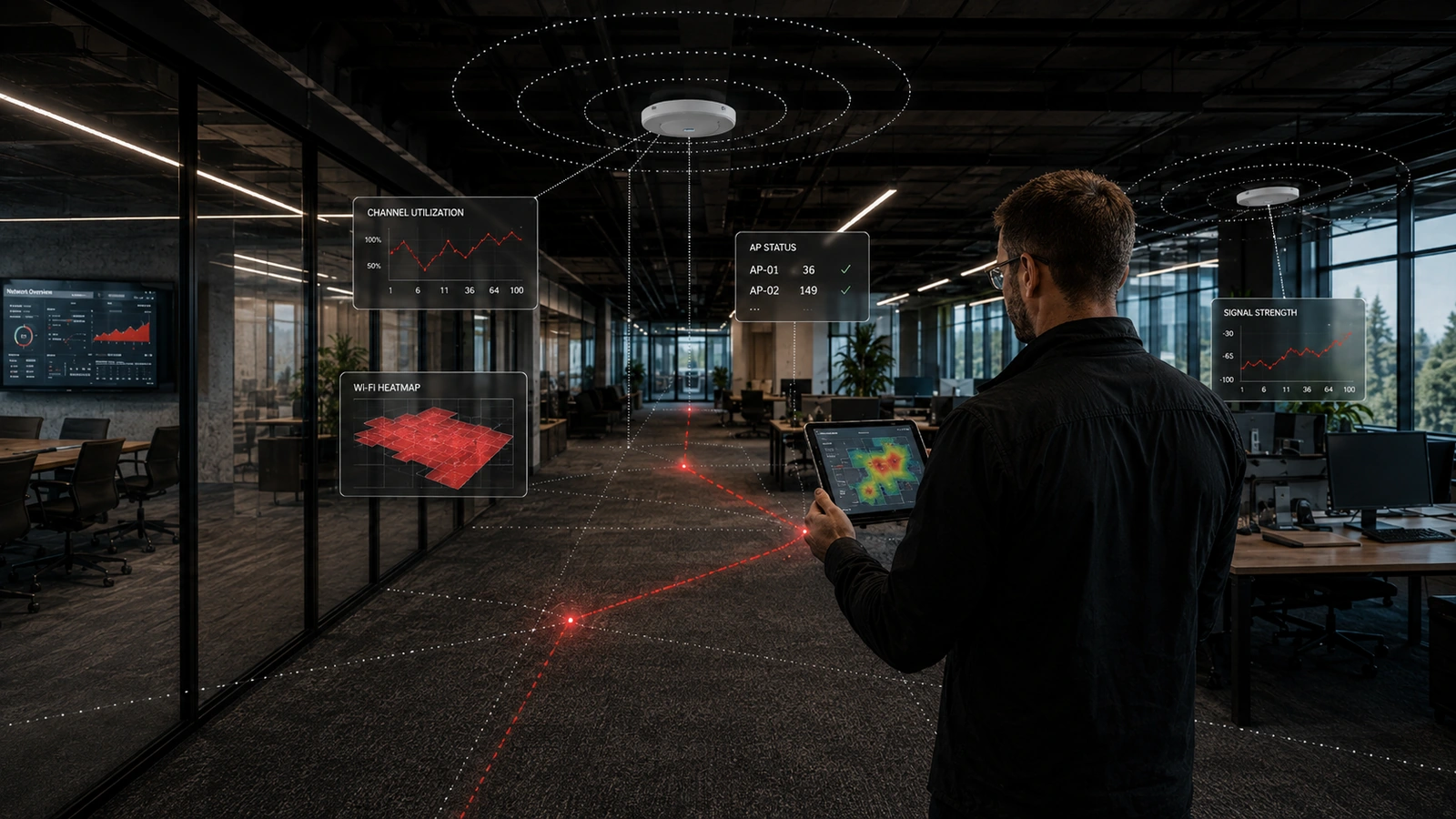
A predictive Wi-Fi 7 design tells you what should happen. A field validation survey tells you what actually does. The gap between the two is usually bigger for Wi-Fi 7 than for previous generations, because several of its headline features degrade quietly under real conditions instead of failing outright.
Why Wi-Fi 7’s own features make validation harder
802.11be’s real gains — 320 MHz channels on 6 GHz, 4K-QAM modulation, and Multi-Link Operation across bands — are each conditional on a clean environment or full client support, not guaranteed once hardware is installed. A design built around ideal assumptions for all three needs a validation pass that checks whether each one actually held up in the real building, with real client devices, not just whether the APs are transmitting.
Checking channel width against reality, not the design
A predictive model often assumes each AP gets its full 320 MHz channel. In a real multi-AP deployment, 6 GHz channel planning frequently can’t give every AP that much room without creating co-channel interference with its neighbors — so part of validation is confirming the channel width actually negotiated in the field matches what the design assumed, not just trusting the design document.
Whether 4K-QAM is actually happening, or silently falling back
4K-QAM’s higher data rate comes at the cost of needing a much cleaner RF environment — higher-order modulation is far more sensitive to noise than the lower QAM levels Wi-Fi has used for years. A client can silently fall back to a lower modulation scheme the moment SNR dips, with no obvious symptom beyond reduced throughput. Validating this means checking the actual MCS (modulation and coding scheme) rate a client achieves during a real session, not just confirming the AP advertises 4K-QAM support.
Whether Multi-Link Operation is actually aggregating, or falling back to one link
MLO’s real gain comes from a client using multiple bands simultaneously. Early Wi-Fi 7 client chipsets have had inconsistent, sometimes partial support for this — a device can associate with an MLO-capable AP and still effectively behave like a single-link client. Field validation should confirm actual multi-link behavior with the client hardware genuinely in use, not assume MLO support from a spec sheet translates into MLO behavior in practice.
The metrics that actually matter, beyond signal bars
Real validation measures throughput per client under realistic concurrent load (not a single-device speed test), retry and retransmission rate, channel utilization/airtime, and roaming behavior between APs using 802.11k/v/r — the same fundamentals that mattered for prior Wi-Fi generations, now checked against Wi-Fi 7’s specific new failure points rather than assumed to be fine because the hardware is new.
How this connects to the rest of a real deployment
None of this replaces the fundamentals covered elsewhere — what actually predicts 6 GHz performance in the first place, or what Wi-Fi 6E and 7 actually fix versus what they don’t. Validation is the step that confirms those fundamentals held up in this specific building, with this specific client mix, not a generic assumption that new standards behave as advertised everywhere.
The practical takeaway
A Wi-Fi 7 deployment isn’t validated by confirming the APs are on and broadcasting — it’s validated by measuring whether channel width, modulation, and multi-link behavior actually matched the design once real hardware and a real building were involved. TekFidelity’s field validation surveys are built around exactly these Wi-Fi 7-specific checks, following the predictive design stage rather than replacing it.