

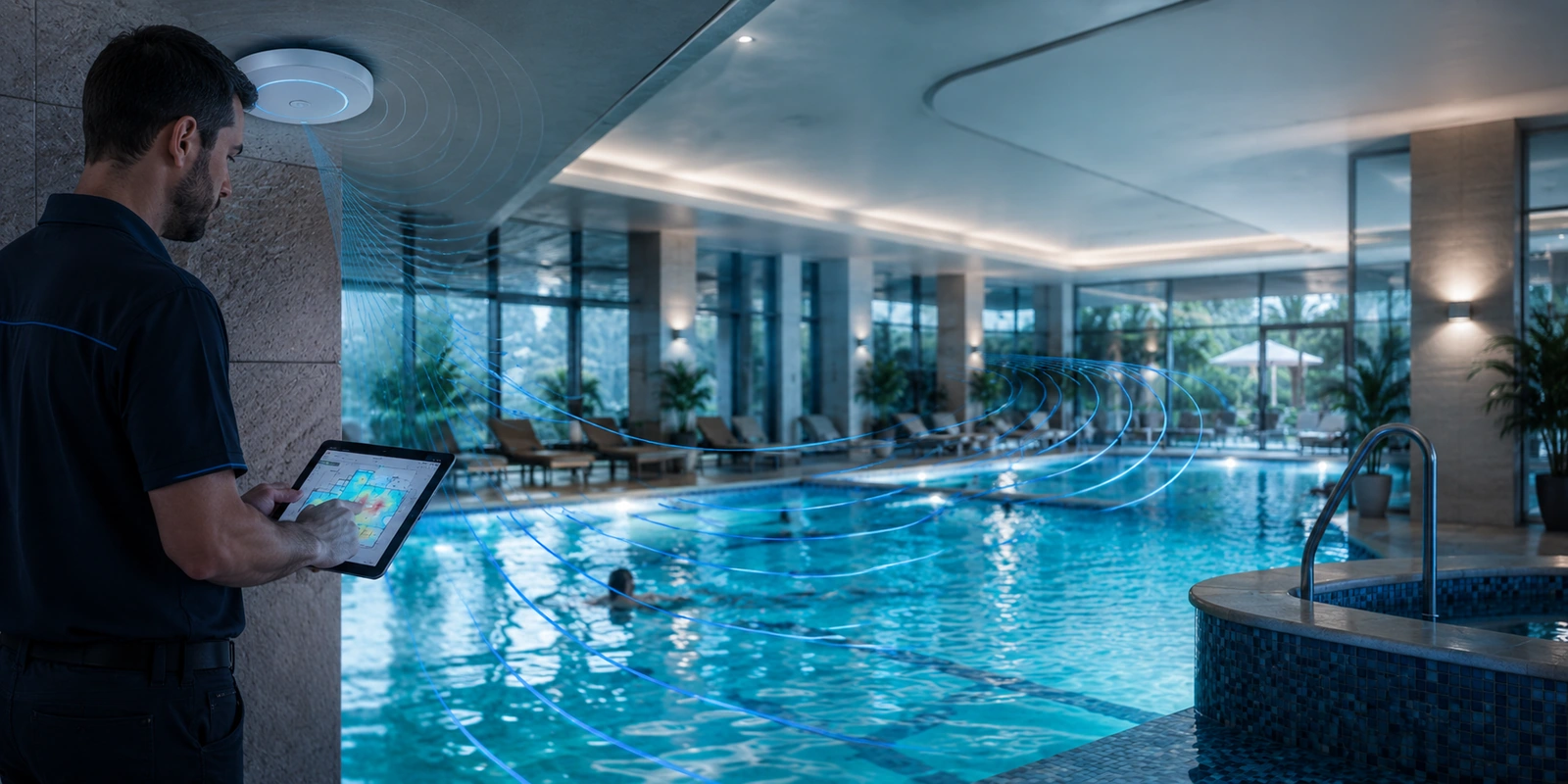
6 GHz doesn’t lose range to humidity in the air. It loses range to physics — and to the water that’s actually in the room, not the water vapor in it.
The 6 GHz band used by Wi-Fi 6E and Wi-Fi 7 runs from 5.925 to 7.125 GHz — the widest contiguous block of spectrum Wi-Fi has ever been handed, and clean of the legacy 2.4 GHz and 5 GHz devices crowding older bands. That range comes at a real cost, and the common explanation for it doesn’t hold up.
Why 6 GHz falls off faster
Free-space path loss increases with frequency. For the same transmit power and distance, a 6 GHz signal loses substantially more energy to ordinary geometric spreading than a 5 GHz or 2.4 GHz signal does — this is basic RF physics, not an environmental condition. Add the higher band’s faster attenuation through walls and furniture, also frequency-dependent and covered in more depth in our breakdown of how wall materials affect Wi-Fi, and 6 GHz’s shorter practical range is fully explained before atmospheric conditions ever enter the picture.
Where water actually matters — and it isn’t the air
Atmospheric water vapor does absorb RF energy, but its significant absorption peaks sit well above 6 GHz — close to 22 GHz for water vapor, and near 60 GHz for oxygen. At 6 GHz, ordinary humidity in the air makes a negligible difference to a Wi-Fi link budget. What genuinely does absorb signal is liquid water: a pool, a decorative water feature, wet foliage, rain across an outdoor link, or standing water between an access point and a client. And critically, so are people. The human body is roughly 60% water, and body attenuation is a well-documented factor in wireless design — a densely occupied room loses real signal margin simply from the bodies filling it, independent of any wall or piece of furniture in the space.
Designing for water-adjacent and densely occupied spaces
This is where the usual guidance for these environments is genuinely useful, once it’s built on the right cause. Indoor pools, spas, greenhouses, and high-occupancy spaces — gyms, cafeterias, a conference room at capacity — all share a real design constraint: more RF loss between the access point and the client than a typical office has to plan for. The correct response is not simply more power. It is designing to SNR, not raw signal strength, since a stronger transmitter pushed into a lossy environment can still leave too little margin above the noise floor. Access point density should be planned for the loss the space actually has, not a generic office assumption, and directional antennas can help concentrate energy where the RF path is already compromised.
For genuinely wet or outdoor-adjacent locations, physical enclosure sealing against moisture ingress is a separate concern from RF absorption — a properly sealed, weatherproof access point still needs its RF budget planned around the space’s real attenuation, not just its own weatherproofing rating.
Why this belongs in the model
A natatorium, a greenhouse, a cafeteria at lunch rush — every environment described here is knowable in advance from the building’s actual use case, not something to discover after installation. A predictive design that accounts for occupancy and water sources gets the access point density and power plan right the first time; a validation survey after installation confirms it against the real, occupied space rather than an empty one during a walkthrough.