

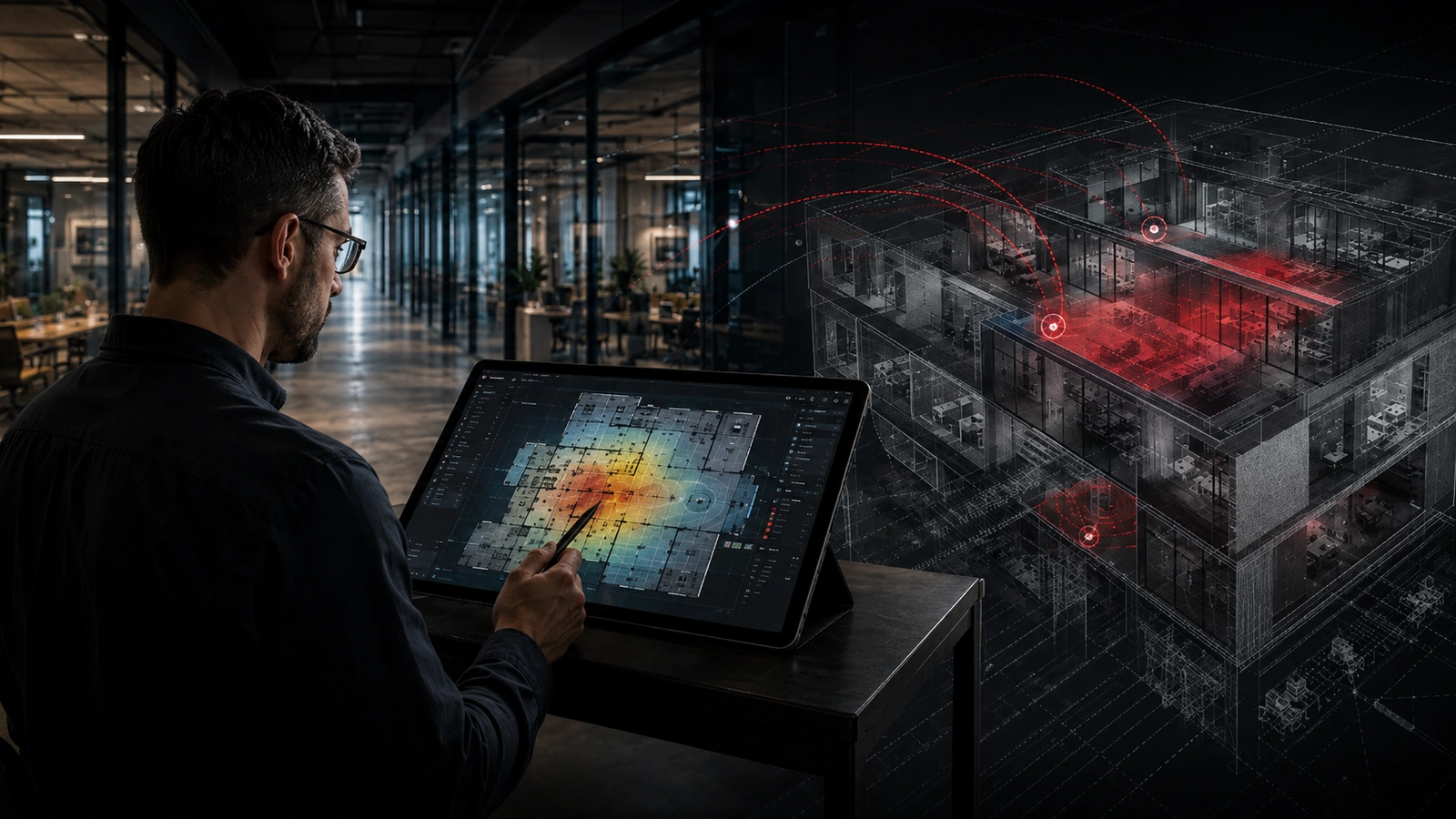
“AI-driven Wi-Fi design” gets used as a marketing label for two very different things: a genuine machine-learning model trained on real deployment data, and an automated lookup table of generic attenuation values dressed up with the word “AI.” The distinction matters, because only one of them actually improves on traditional predictive modeling.
What the machine learning in a tool like Ekahau AI Pro actually does
Traditional predictive design relies on a designer manually tagging wall materials on a floor plan — concrete, drywall, glass — each assigned a generic attenuation value from a reference table. A genuine ML-assisted tool is trained on a large set of real, previously-validated deployments and learns to recognize likely material types and realistic attenuation patterns directly from floor-plan imagery, reducing (not eliminating) the manual tagging burden and often catching material assumptions a human would have guessed at generically.
Where this genuinely beats a flat attenuation table
A reference table treats building materials and wall thickness as one number per category regardless of context. A model trained on real outcomes can learn that a drywall partition in a specific building type, combined with typical furniture density and ceiling height, correlates with a different real-world result than the generic value assumes — because it’s learned from actual measured deployments, not just physics-textbook attenuation coefficients applied uniformly.
The real limitation: it’s only as good as its training distribution
A model trained on a large set of past commercial buildings performs well on buildings that resemble that set. A building with unusual construction — heavy structural steel in an atypical configuration, an uncommon material combination, an unusually shaped floor plan — can fall outside what the model has seen, and its placement suggestion becomes a confident-looking guess rather than a validated prediction. This is exactly why field validation stays necessary regardless of how sophisticated the predictive tool is: the model’s confidence and its actual accuracy aren’t the same thing outside its training distribution.
Where AI-assisted modeling helps with capacity, not just coverage
Beyond wall attenuation, the more useful application is capacity estimation — modeling realistic client density and airtime demand based on space type and historical usage patterns (a classroom’s usage profile looks nothing like an open-plan office’s, which looks nothing like a warehouse’s) rather than a single flat client-count assumption applied everywhere. This is where “AI-driven” earns the label: learned usage patterns feeding a capacity model, not a generic per-square-foot rule.
The question worth asking about any tool claiming this
Before trusting an “AI-driven” claim, ask specifically what is being learned from data versus what’s still a hard-coded physics rule or lookup table with a new label. A vendor who can answer that specifically is describing a real capability; a vendor who can’t is probably describing automation, not machine learning.
The practical takeaway
AI-assisted predictive design is a genuine improvement over flat attenuation tables when it’s actually learning from real deployment data — and it still requires field validation, not a replacement for it. TekFidelity’s Predictive Wi-Fi Design work uses Ekahau AI Pro for exactly this reason, paired with on-site validation to confirm the prediction against the building the model hasn’t actually seen.