

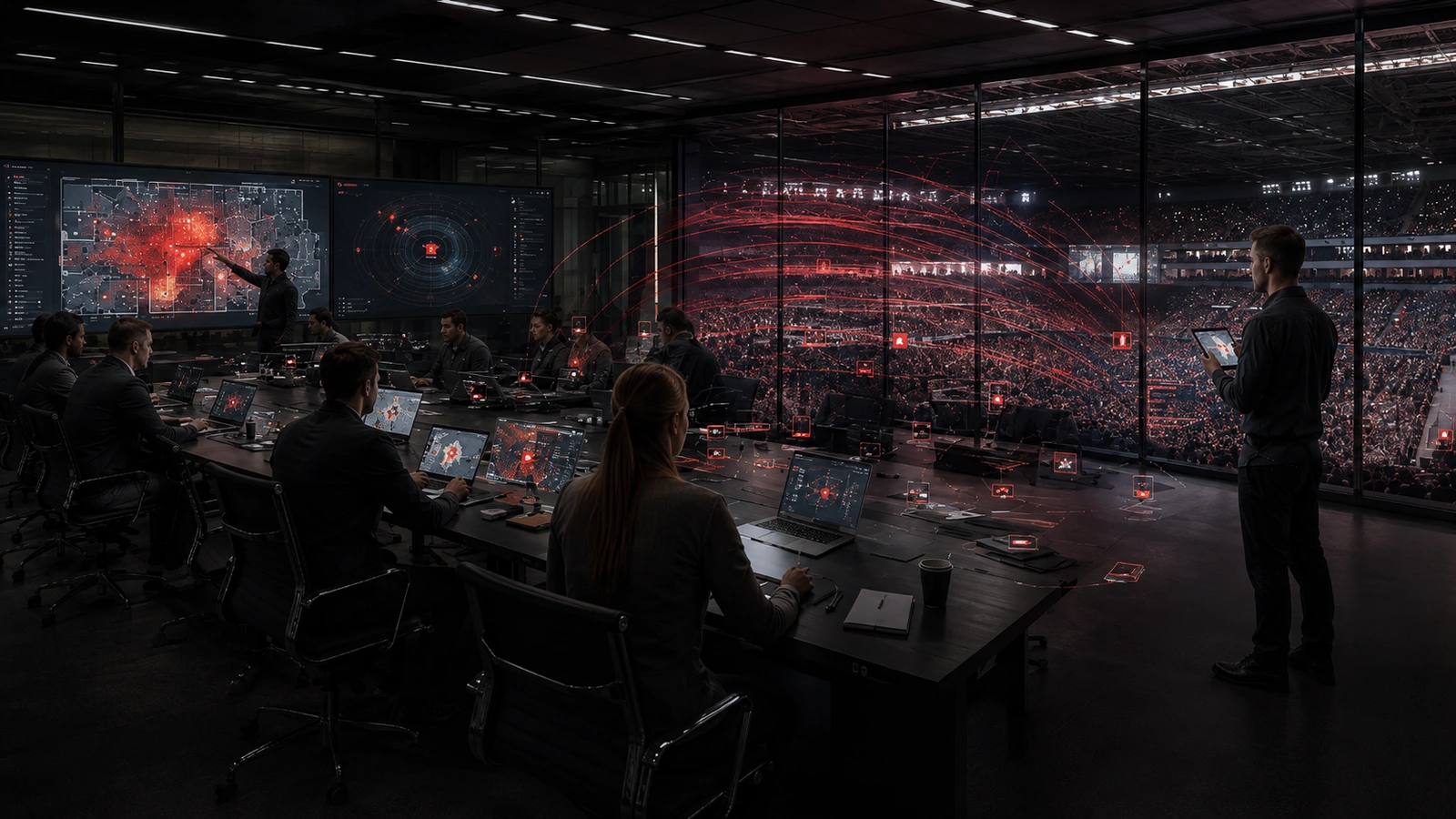
A design that guarantees strong signal everywhere and a design that guarantees good performance everywhere are not the same design. The gap between them shows up hardest in exactly the spaces built to hold a lot of people at once — auditoriums, classrooms, conference centers — where “full bars” and “unusable” turn out to be compatible facts.
Why RSSI alone can’t predict what a busy room actually needs
Signal strength describes whether a client can hear an access point clearly. It says nothing about how many other clients are also trying to use that same access point at the same time, or how the fixed amount of available airtime gets divided among them. A coverage-only design can hit its RSSI target everywhere in a room and still produce a network that performs badly the moment real occupancy shows up — because airtime, not signal strength, is the resource actually running out.
What a capacity-based design actually models
Rather than just placing APs to hit a signal threshold, capacity-based design starts from expected concurrent client count, devices per person, and the application mix in use — video conferencing needing a few sustained megabits with low jitter, VoIP needing low latency but little bandwidth, general browsing tolerating more variance. That input drives AP density and channel/band assignment directly, rather than treating device count as an afterthought once the coverage model is already finished.
The real number that changes the design: clients per AP
There’s no single universal ceiling, but a useful working reality: an AP that comfortably serves 20 people doing light browsing can degrade badly at 50-plus concurrent devices doing video or heavy uploads, because each additional client competes for the same shared channel time. Real capacity design sizes AP count and channel width to the actual expected load in a specific room type, not a flat “one AP per square footage” assumption that a coverage-only approach would use.
Band steering and channel planning are part of the same problem
Pushing capable dual- or tri-band clients toward less congested 5 GHz or 6 GHz channels, rather than letting every device default to the most crowded band, is a direct capacity lever — it’s not a coverage decision, it’s a load-balancing one. A design that only reasons about coverage has no mechanism for this at all, because it never modeled contention in the first place.
How to actually test for this before it’s a complaint
A single-device speed test proves almost nothing about capacity. The real test is aggregate throughput under many concurrent, realistic clients — the exact condition a coverage-only survey never simulates, and the exact condition that reveals whether a strong signal actually means good performance in this specific room, or just looks like it should on paper.
The practical takeaway
Coverage answers “can a device hear the network here.” Capacity answers “does the network still work when everyone in this room is using it at once” — and only one of those questions predicts what a full auditorium or a packed conference room actually experiences. TekFidelity’s Predictive Wi-Fi Design work models capacity explicitly for high-density spaces, not as an add-on to a coverage plan.