

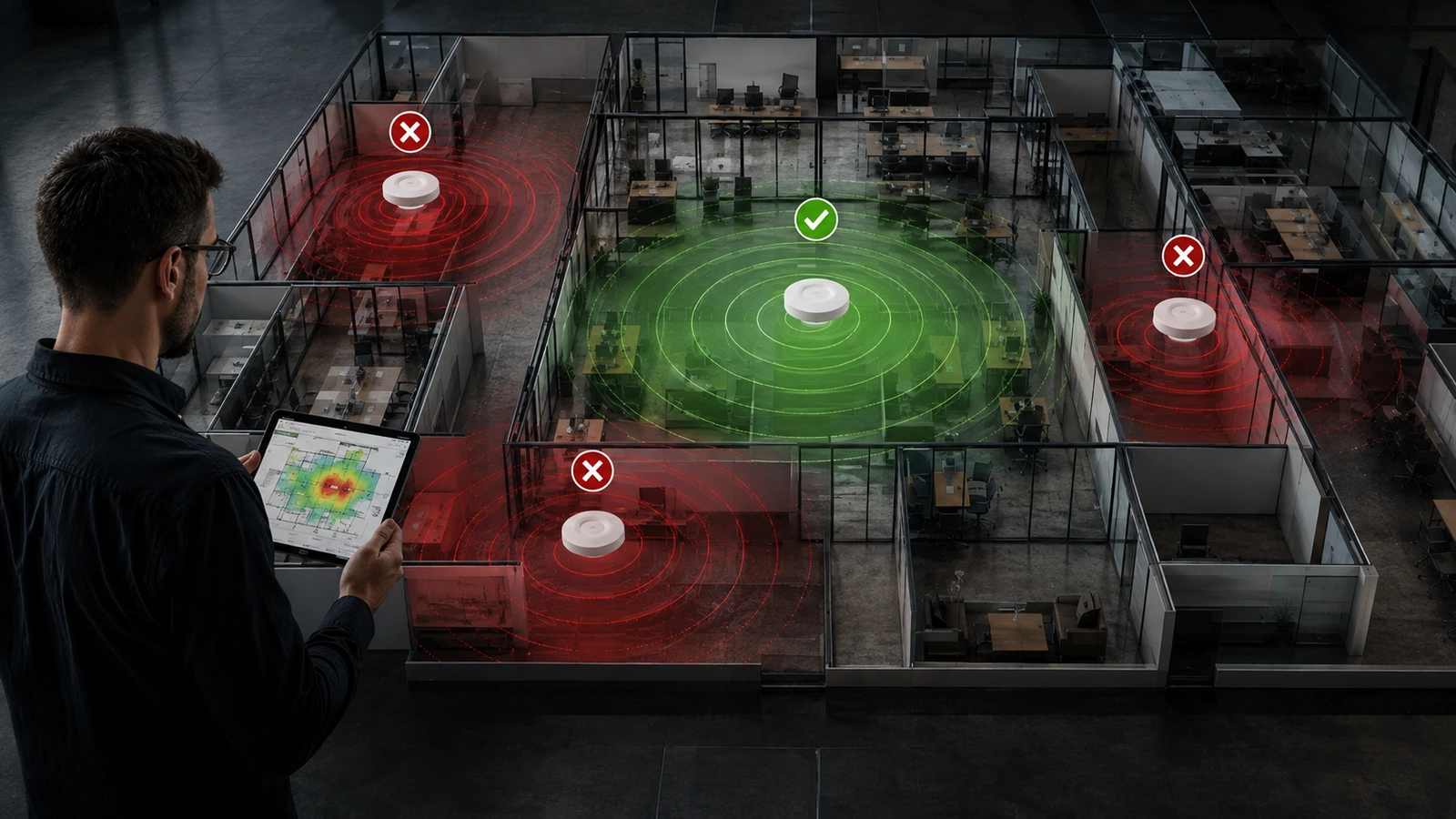
Most AP placement advice is a set of rules of thumb that were never true in every environment and are actively wrong in a growing number of them. Here are the four that cause the most real damage, and what actually determines placement instead.
Myth: more access points always means better Wi-Fi
Adding APs without replanning channels and power increases co-channel contention — every AP now competes for airtime with more neighbors on the same channel, and throughput per device can drop even as coverage looks stronger on a phone’s signal bars. An extra AP is a capacity fix only when it’s paired with a channel/power replan across the whole area, not a standalone move.
Myth: the center of the room is the right spot
Placement should follow RF propagation and the building’s actual materials and layout, not floor-plan geometry. A ceiling-mounted AP in an open area behaves completely differently from the same AP wall-mounted behind a filing cabinet bank or above a drop ceiling with metal HVAC ductwork — “center of the room” is a floor-plan concept, not an RF one, and it ignores everything that actually attenuates or reflects the signal between the AP and the client.
Myth: higher transmit power means better coverage
This one ignores the uplink. An AP can transmit at up to 23-30 dBm, but the phone or laptop answering it typically transmits at only 15-20 dBm — a real, asymmetric link budget. Cranking AP power to “reach further” creates a zone where the client can hear the AP clearly but the AP can’t hear the client’s much weaker reply, producing exactly the flaky, one-direction-only connection this myth was supposed to fix.
Myth: one AP per room is a reasonable rule of thumb
AP count is a capacity question, not a room-count question. A single AP can blanket a large room with strong signal and still fail badly the moment 60 concurrent laptops and phones try to use it, because airtime — not signal strength — is the resource running out. A small room with dense simultaneous use can need more capacity than a large room with light use, which no per-room rule captures.
The number that actually matters: target SNR, not signal bars
Signal strength alone (RSSI) doesn’t predict a good connection — signal-to-noise ratio does. A real design targets roughly -67 dBm or better at the edge of coverage with at least 25 dB of SNR margin, not just “full bars” on a phone, because a strong signal sitting in a noisy RF environment still performs badly. (See our breakdown of why -67 dBm alone is not a complete Wi-Fi design requirement for the full reasoning.)
What a real AP-density decision looks like
Take a 150-by-100-foot open-plan office with 80 people each carrying a laptop and a phone concurrently connected. Signal strength alone might be satisfied by two or three APs. Capacity is not — at that device density, a predictive design has to account for per-AP client load and airtime contention, not just square footage, which is exactly why a “one AP per 1,000 square feet” rule produces a design that looks fine on paper and performs badly in the room.
The practical takeaway
AP placement is a capacity and RF-propagation decision, not a geometry or rule-of-thumb one. TekFidelity’s Predictive Wi-Fi Design work models this before anything is installed, and Site Surveys & Validation confirms it holds up once the space is actually in use.